Can an LED Mirror Be the Only Light Source in Your Bathroom?
An LED mirror can make the vanity look bright while the shower, floor and storage remain dim. Here is how to decide whether your mirror can illuminate the bathroom—or should be one layer in a better lighting plan.
Shop LED mirrorsGet the answer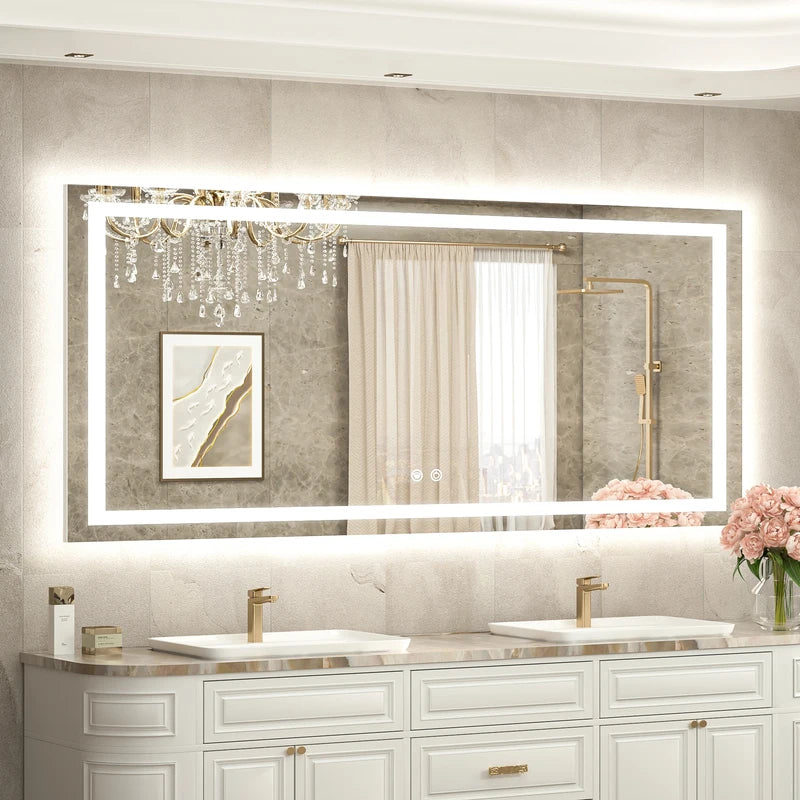
Usually no—but a strong frontlit mirror may be enough in a very small, simple bathroom
An LED mirror is primarily positioned at the vanity, so much of its useful light serves a vertical task: your face. Whole-room lighting has a different job—safe movement, finding items, cleaning and seeing the shower, toilet, floor and corners.
A compact powder room may function with a bright mirror alone. In a bathroom with a shower, separate toilet zone, dark tile, tall storage or no daylight, relying on the mirror alone often creates uneven illumination.
See your face
Front-facing mirror LEDs or vertical sconces reduce grooming shadows.
See the room
Ceiling, wall or indirect light supports movement and general visibility.
Shape the mood
A backlit halo adds depth; low-level lighting supports late-night use.
Lumens, lux and foot-candles are not interchangeable
Total light output
Lumens describe how much visible light a source emits. They do not tell you where that light lands.
Light arriving on a surface
One lux equals one lumen per square meter. Distance, direction and room surfaces strongly affect it.
Imperial illuminance
One foot-candle equals one lumen per square foot. Lighting targets apply at a specific surface or task plane.
A rough planning calculation—not a final design
Room lumens ≈ floor area in square feet × target lumens per square foot
DOE remodeling guidance gives a broad bathroom range of roughly 5–50 lumens per square foot, with the lower end associated with ambient needs and the higher end with task/accent needs. This is intentionally broad: dark finishes, older eyes, high ceilings and poor fixture distribution can require more useful light.
Example: A 60-square-foot bathroom at 20 lumens per square foot suggests roughly 1,200 lumens as an early estimate. It does not prove a mirror rated at 1,200 lumens will light the room, because much of its output may point toward the user or wall rather than the floor, shower and corners.
Why a high-output LED mirror can still leave the bathroom dark
| Factor | Why it matters | What to check |
|---|---|---|
| Light direction | Front light targets the face; backlight targets the wall. Neither automatically spreads evenly across the room. | Frontlit, backlit or dual-lit construction |
| Mirror location | A vanity on one wall cannot directly illuminate a shower behind a partition. | Floor plan, door and glass positions |
| Surface reflectance | White tile reflects more light than charcoal stone, dark paint or wood. | Wall, floor, ceiling and counter colors |
| Room geometry | Alcoves, tall cabinets and separate toilet rooms create shadowed zones. | Every circulation and task area |
| Glare and contrast | A bright halo in a dim room can make the surroundings feel darker as your eyes adapt. | Visible LED brightness versus background light |
| Daylight | A window can make mirror-only lighting appear adequate during the day but fail at night. | Test after sunset |
| User needs | Older occupants and detail-oriented grooming may benefit from more, better-distributed light. | Who uses the room and for what |
Six signs the LED mirror should not work alone
1. Your face is bright, but the floor is dim
Cause: mirror light is concentrated vertically.
Fix: add a diffused ceiling fixture or soft indirect ambient light.
2. The shower looks shadowy
Cause: partitions and distance block vanity light.
Fix: install an appropriately rated shower-area fixture where permitted.
3. Backlighting makes the wall glow—not your face
Cause: rear LEDs are mainly ambient/accent light.
Fix: choose front + back lighting or add vertical sconces.
4. The mirror feels harsh at full brightness
Cause: high contrast between the LED and dark room.
Fix: add low-glare ambient light and dim the mirror.
5. Makeup looks different outside
Cause: color temperature, CRI or uneven face lighting.
Fix: use CRI 90+ neutral light and balanced front illumination.
6. Nighttime use is too bright
Cause: the only option is full vanity light.
Fix: add a separate low-level night circuit or dimmable ambient source.
When can an LED mirror illuminate the bathroom by itself?
It may work when all are true
- The room is a compact powder room or very small bath
- There is no enclosed shower or dark toilet alcove
- Walls and ceiling are light and reflective
- The mirror uses bright front-facing or dual lighting
- The output and distribution are verified for the selected size
- Night testing shows the floor and room edges remain visible
- The plan meets applicable safety and code requirements
Add other lighting when any are true
- The bathroom includes a shower or tub zone
- Tile, paint or cabinetry is dark
- The mirror is backlit-only
- The layout has partitions, corners or a toilet room
- The mirror produces glare against a dark background
- Users need higher visual comfort or more detail light
- The mirror is decorative rather than photometrically designed for the room
TETOTE LED mirror types to compare
Frontlit & Backlit LED Mirror
Front, back or combined illumination with CRI 90+, three color temperatures, dimming and memory.
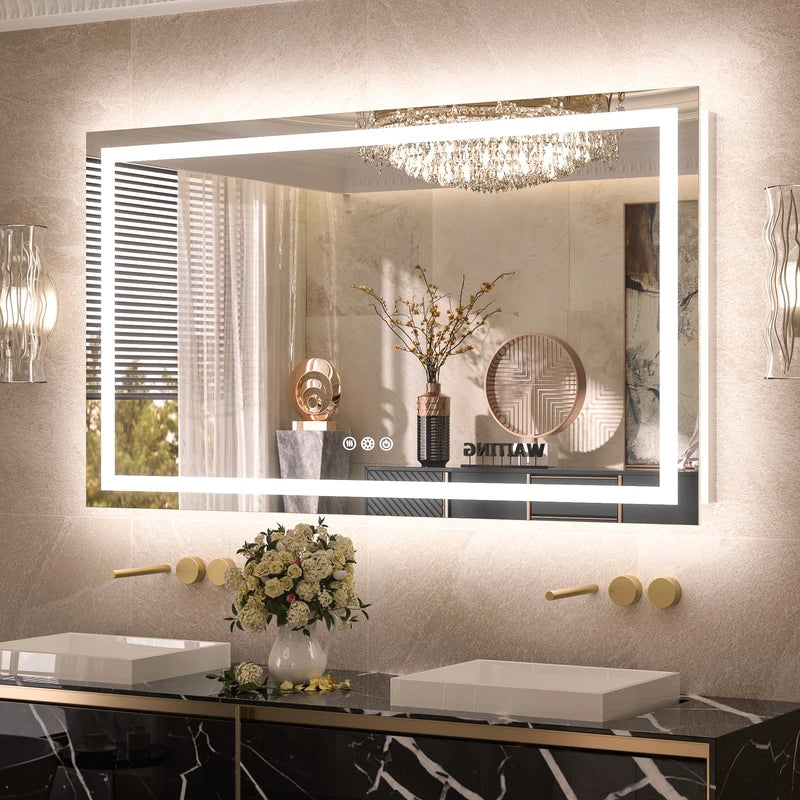
Vanity Mirror with Dual LED Lights
Independent front, rear and combined modes with a listed peak illuminance up to 9,500 lux for selected configurations.
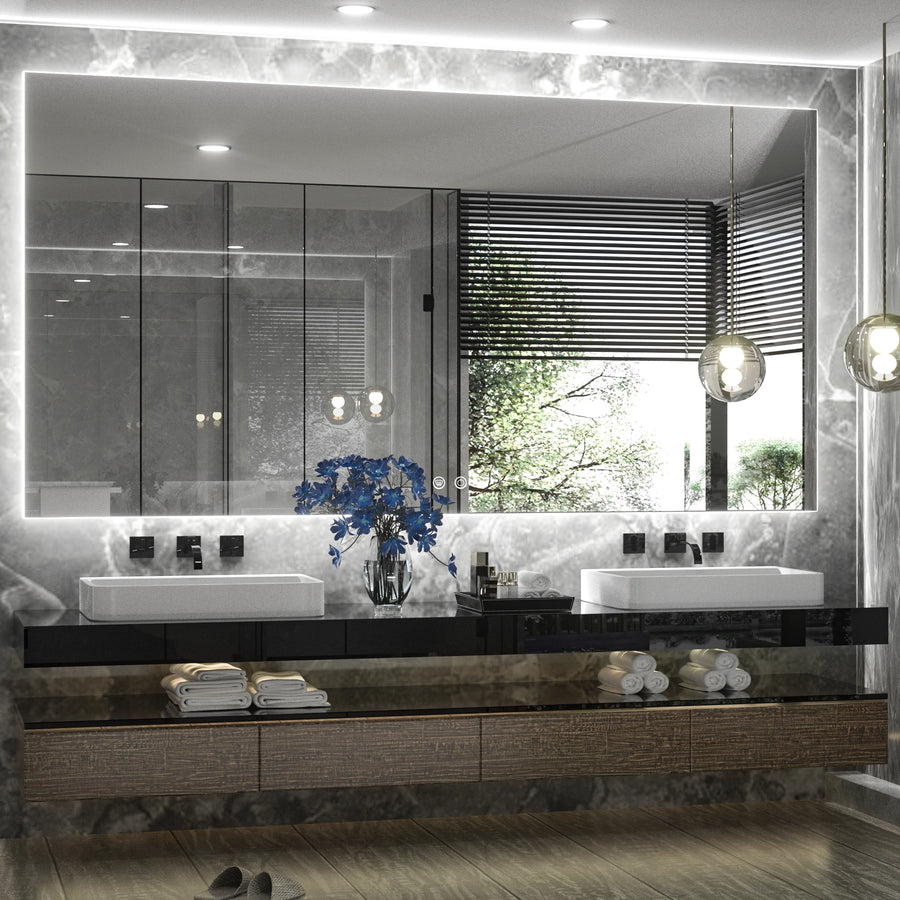
Backlit Bathroom Mirror
Rear-facing LEDs create a floating wall glow with adjustable temperature, dimming, memory and defogging.
A simple layered bathroom lighting plan
1. Start with the vanity
Choose front or dual lighting sized to the mirror and grooming needs.
2. Fill the room
Add diffuse ceiling, wall-wash or indirect ambient illumination.
3. Cover wet zones
Use correctly rated fixtures where the shower, tub or local rules require them.
4. Separate controls
Let users run mirror, ambient and night lighting independently and dim where appropriate.
After dark, turn on only the proposed LED mirror. Can you safely see the floor, threshold, toilet, shower controls, storage and room edges without glare? If not, the mirror is doing its task-light job—but the bathroom still needs ambient light.
LED mirror lighting FAQs
Can an LED mirror illuminate a whole bathroom?
Sometimes in a very small, light-colored room, but most bathrooms benefit from separate ambient lighting because mirror LEDs are concentrated near the vanity.
How many lumens does a bathroom need?
There is no single universal number. A broad DOE remodeling rule of thumb spans approximately 5–50 lumens per square foot depending on ambient versus task needs. Room finishes, distribution, age and layout matter.
Is lux more important than lumens?
Both answer different questions. Lumens describe source output; lux describes how much light reaches a surface. For grooming, illuminance and uniformity at the face matter more than a large lumen number alone.
Is a backlit mirror enough for makeup?
Usually not by itself. Rear halos primarily illuminate the wall and can create contrast. Front-facing vertical light or sconces generally serve facial tasks better.
What color temperature is best?
Neutral light around 4000–4500K is a versatile grooming setting. Warm 3000K feels calmer, while 6000K appears cooler and crisper. Adjustable mirrors provide flexibility.
Does a larger LED mirror always make the bathroom brighter?
Not necessarily. A larger model may have more LEDs, but direction, driver output, wall reflectance and layout determine how much useful light reaches the room.
Should bathroom lights be on separate switches?
Separate or scene-based control is useful because task, ambient, defogger and night lighting serve different needs. Electrical design must follow applicable local requirements.
Light the face—and finish the room
Compare TETOTE frontlit, backlit and dual-lit mirrors for your vanity lighting plan.
Shop LED bathroom mirrors